
Guardrails
Hunter's constraint stage: worst-day and simultaneous-stop caps, the combined-DD cap and what it honestly can't promise, correlation, entry-timing concentration, and the advanced limits.
Stage 3 collects the limits every result must respect. All of them are optional, and the stage says so up front: "Optional safety limits. Leave a field blank when you do not want that rule." An empty field means the constraint does not exist — Hunter never assumes a limit you didn't set.
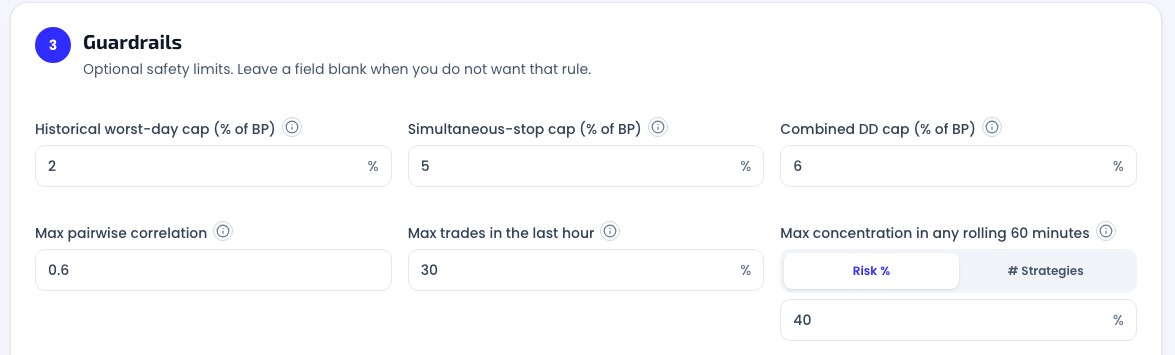
Historical worst-day cap (% of BP)
Reads every day of the reference window and rejects any portfolio whose single worst combined day — all picks together, contract-weighted — exceeds this share of the budget. From the help text: "with $100,000 buying power and 2%, the worst historical day may lose at most $2,000." This is a hard constraint on the actual daily series, not on an average.
Simultaneous-stop cap (% of BP)
Caps the theoretical worst day — if every strategy hits its stop at once — as a share of the budget. Loss when a spread stops equals premium × stop-multiple, so this bounds Σ(premium × stop-loss × contracts) across the picks. It is structural and regime-independent: computed from the strategy definitions alone, no daily series involved. The product describes it as "intentionally more conservative than the historical worst day" — the historical cap bounds what did happen; this bounds what could, with one caveat that matters: it assumes stops fill. In a gap or fast dislocation, stops can fail and losses approach the full spread width.
Combined DD cap (% of BP)
Caps the true combined-curve max drawdown — the worst peak-to-trough of the whole portfolio's daily equity over the reference window, read from the picks' real daily series, not an average of per-strategy percentages — at your chosen share of the budget.
What it cannot do is bind the future. The cap applies to the reference window the search optimizes — it is an in-sample shaping constraint, not a forward limit, and realized drawdowns after selection can exceed it. Our 2026-07 walk-forward study measured exactly this: one low-DD configuration replayed over 3 years exceeded its 1.5% cap in all 11 quarters tested, with a stitched max drawdown about 6.3× the cap. Tightening the cap is still useful — it makes the optimizer shed exposure and bring in wider, less-correlated spreads — but the number itself describes the past window, nothing more.
Max pairwise correlation
Forbids selecting any two strategies whose reference-window daily-P/L correlation exceeds your threshold. From the help text: "at 0.60, a pair with 0.72 correlation is rejected." Its practical value is killing near-duplicates — two 10:05 50-wides fifty cents apart are one bet, not two. Lower = stricter. Like the combined-DD cap, this reads daily series and adds a moment to the run.
Max trades in the last hour
Limits the share of the portfolio entering at or after 15:00 ET: "at 30%, a 10-strategy portfolio may contain at most 3 last-hour strategies. Contract counts do not change this percentage." Late entries have little session left to recover from a move against them; this bounds how much of the book lives there.
Max concentration in any rolling 60 minutes
The anti-clustering rule, with a mode toggle — the two modes are mutually exclusive:
- Risk % — no moving 60-minute window of entry times may contain more than this share of the portfolio's total stop-risk dollars. Risk-based: a window holding one large-premium strategy can bind before a window holding three small ones.
- # Strategies — no moving 60-minute window may contain more than this count of strategies, regardless of size: "at 3, no one-hour group may contain more than three strategies. Contract counts do not change this limit."
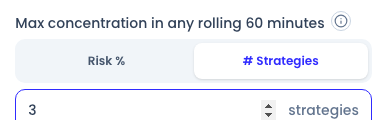
The window rolls — it is not fixed clock hours. Entries at 10:31, 10:59 and 11:29 all sit inside one 60-minute window starting 10:31, so clustering can't hide on an hour boundary.
Advanced limits
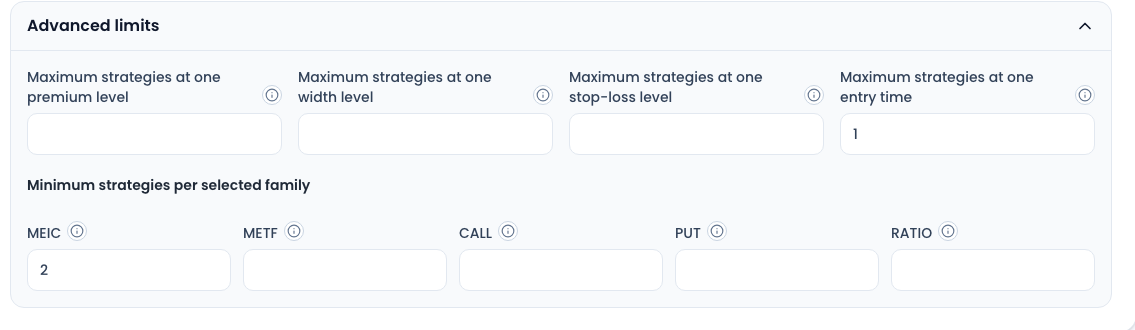
Collapsed by default, for portfolio-shape rules most runs don't need. Four concentration caps, each a whole number of strategies (1–40) sharing one exact value:
| Cap | What it bounds |
|---|---|
| Maximum strategies at one premium level | Picks sharing the exact same premium — "at most four $4.00 strategies; $3.50 strategies are counted separately" |
| Maximum strategies at one width level | Picks sharing one spread width |
| Maximum strategies at one stop-loss level | Picks sharing one stop percentage |
| Maximum strategies at one entry time | Picks opening in the same exact minute — set it to 1 to forbid duplicate entry times entirely (the original Hunter's checkbox rule, now a number) |
Below them, Minimum strategies per selected family shows one field per family present in your universe: "entering 2 requires at least two MEIC strategies; leave it blank to allow any number, including zero." This is how you guarantee a mix — for example forcing METF trend-followers into a book the optimizer would otherwise fill with MEIC alone.
Reading this stage as a whole
Each guardrail states its own limits: the worst-day cap describes the past window, the simultaneous-stop cap assumes stops fill, the combined-DD cap shapes the in-sample curve without promising anything forward. Constraints shape what the search returns; they are not promises about what the market will do to the result.
Related pages
Get the weekly 0DTE research email
Research notes and product updates, straight to your inbox. Unsubscribe anytime.