
Filters
Every filter in the Strategy Browser explained: search, width, stop loss, premium, entry time, minimum entry spacing, and best-per-entry-time.
Filters narrow the catalog by a strategy's parameters — what the strategy is. (To narrow by its results — what it did — use Min Thresholds.)
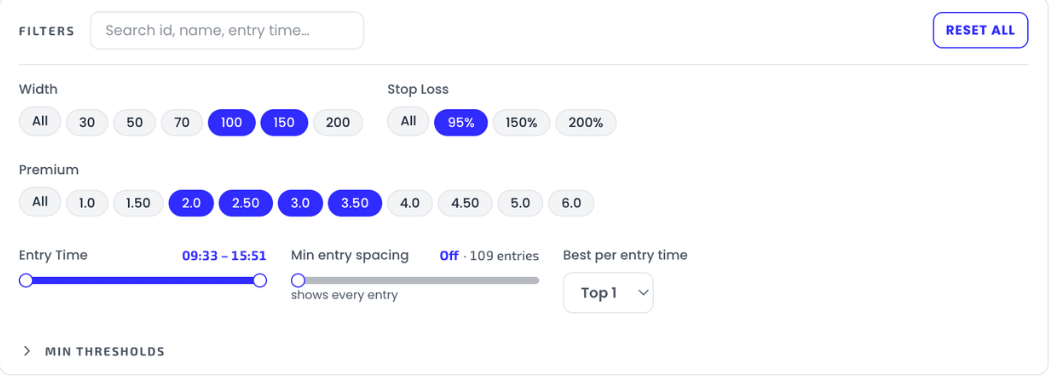
Every chip row has an All chip that clears that filter, and Reset all (top right) resets everything — filters, thresholds, and scope — in one click.
Search
The search box matches against strategy id, display name, and entry time — the
fastest way to jump to a specific setup, e.g. typing 15:27 or MEIC.
Width

Spread width in points — the distance between the short and long strikes. The chips (e.g. 30 / 50 / 70 / 100 / 150 / 200) come straight from the database; multi-select is allowed. Width drives both the maximum loss and the margin of a spread: max loss per contract = (width − premium) × 100.
Stop Loss
Stop loss as a percentage of the credit received. A $3.00 credit spread with a 95% stop closes when the loss reaches roughly 95% of that credit. The available levels (e.g. 95% / 150% / 200%) are the ones the database was backtested with — every row already includes its stop-loss behavior in the results.
Premium

Target premium (credit) collected per spread, in dollars. Higher premium means more income per trade but typically strikes closer to the money — a different risk profile, not a free upgrade.
Entry Time

The time of day (ET) the position is opened. The range slider spans the roughly 109 distinct entry times in the database, from 09:33 to 15:51, on an alternating 3–4 minute grid. Narrow it to focus on, say, morning entries only.
Min entry spacing
Thins that entry-time grid to a minimum cadence — Off, 7, 10, 14, 17, 21, 31, 45 or 63 minutes — and shows how many entries survive. Why you'd care: strategies entered minutes apart are highly correlated (they see nearly the same market), so a portfolio of ten entries three minutes apart is far less diversified than ten entries spread across the day. The label under the slider grades the effect, from "shows every entry" to "meaningful decorrelation".
Best per entry time
Keeps only the best N strategies (by the ranking metric) at each entry time — All, or Top 1 through Top 4. This is the declutter tool: a dense grid of near-duplicates becomes one line per entry time, and the catalog reads like a menu instead of a wall.
Related pages
Get the weekly 0DTE research email
Research notes and product updates, straight to your inbox. Unsubscribe anytime.