
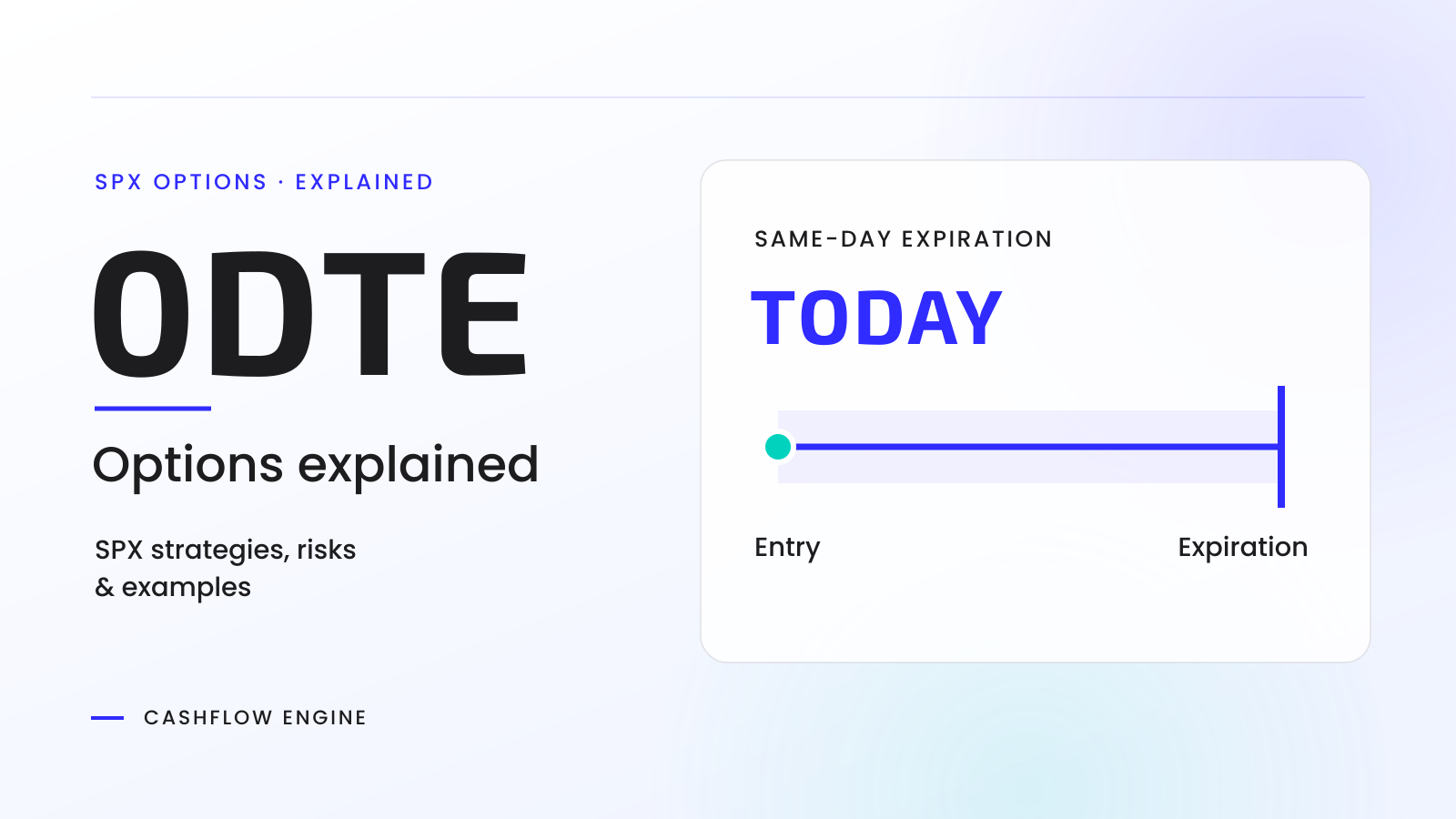


Zero Days to Expiration — an option with its expiration date on the current trading day. 0DTE describes time remaining, not a distinct contract type or a requirement that the option was issued that morning.
The useful question is what happens between entry and expiration: how the contract settles, how losses develop, and whether a tested rule survives real execution. This guide connects those mechanics to strategy design, with a worked example and evidence from the Cashflow Engine backtest dataset. Our Cashflow Engine software provides a database of pre-computed SPX 0DTE strategy backtests, with tools for comparing rules and analyzing portfolios.
What are 0DTE options, and why did they become popular?
0DTE is a point in an option's life, not a strategy by itself. Buying a call, selling a put spread, and opening an iron condor can all use the same expiration while producing very different exposures.
More frequent expiration listings made same-day trading possible across more sessions. The appeal is concentrated exposure to a single day's price movement and a short commitment of capital. Neither feature establishes that a trade has positive expectancy. FINRA's 0DTE overview explains the distinction between a contract's listing date and its expiration-day use.
For a buyer, a small premium can be lost completely. For a seller, collecting a small premium can create a much larger obligation. A short trading window changes the timing of risk; it does not remove it.
An expiration-day position also need not be held until expiration. A strategy can specify an earlier exit, a profit target, a price-based stop, or another condition. Those choices belong in the rules being tested.
How do SPX 0DTE options work?
SPXW options settle in cash and cannot be exercised early. The expiring PM-settled series ordinarily stops trading at 4:00 p.m. Eastern Time, or 1:00 p.m. on an exchange half-day. Standard AM-settled SPX monthlies have different settlement mechanics. Cboe's SPX specifications distinguish the expiration trading cutoffs.
The $100 multiplier turns quoted points into dollars: a 2.00-point premium equals $200 per contract. At expiration, a call's intrinsic value is the amount the settlement value exceeds its strike; a put's is the amount its strike exceeds the settlement value. That amount is multiplied by $100.
| Contract | Settlement | Exercise style | Operational distinction |
|---|---|---|---|
| SPXW, PM-settled | Cash | European | Same-day closing settlement; no early share assignment |
| Standard SPX, AM-settled | Cash | European | Opening-based settlement; last trading day precedes settlement |
| SPY options | ETF shares | American | Exercise or assignment can produce a stock position |
| XSP options | Cash | European | One-tenth the SPX index scale; a different order book |
These distinctions follow Cboe's S&P 500 option product comparison. European-style describes exercise timing, not where the trader lives; a position can still be closed during available trading hours.
The phrase “no overnight risk” needs qualification. A settled SPXW contract leaves no stock position, but an ETF option can create shares that remain after expiration. See our guides to SPX settlement and SPX vs SPY options.
Why do theta and gamma matter so much near expiration?
Theta measures sensitivity to time passing; gamma measures how quickly delta changes as the underlying moves. Near expiration, at-the-money options can have especially high gamma, making a position's directional exposure change sharply. The Options Industry Council's gamma explanation describes this concentration around the strike.
Delta is the first-order estimate of an option's price response to an underlying move. High gamma means that estimate can change quickly: a position that looked modestly directional at entry can become much more sensitive after the index approaches a strike.
Theta is a model sensitivity with other inputs held constant. It is not a guaranteed stream of profit. A seller may benefit from declining time value while losing more from an adverse index move. A buyer can get the direction right but still lose if the move is too small, arrives too late, or fails to overcome the price paid.
Implied volatility also affects premiums, but its dollar impact depends on moneyness and remaining time. “Every 0DTE option is extremely sensitive to volatility” is too broad. The relevant question is which exposures the actual legs create, at the current price and time.
What does our 0DTE options strategy research show?
The backtest evidence shows why win rate alone is an incomplete description of a strategy. Across three ungated credit-spread families, median simulated win rates were similar while modeled profit per entry and drawdown differed.
The Cashflow Engine database contains hundreds of thousands of backtested strategies, using second-level options data, and we add strategies every day. The historical research behind the following table covered 39,213,580 simulated per-side fills from May 16, 2022 through July 9, 2026. It summarizes overlapping strategy configurations, not independent experiments.
| Simulated strategy family | Median maximum drawdown on $100,000 basis | Median win rate | Median modeled P&L per contract per entry |
|---|---|---|---|
| Both-side credit spreads, iron condor family | 7.1% | 63.2% | $20.47 |
| Call credit spread | 8.7% | 62.5% | $4.93 |
| Put credit spread | 8.2% | 63.9% | $13.44 |
Source: Cashflow Engine backtest data, May 16, 2022–July 9, 2026. Modeled P&L was net of commissions and modeled slippage. These are separate medians across configurations, not the metrics of one representative portfolio.
A narrow range of winning percentages concealed a much wider range of modeled economics. That is the educational finding. It is not a ranking of strategies to trade, and the historical drawdowns are not upper bounds on future losses.
In the Cashflow Engine Strategy Browser, the database makes those differences inspectable through strategy parameters, historical equity curves, drawdowns, and risk metrics. The figures in this article are a frozen research extract, not a claim about the database's latest coverage.
The sample also shares market days across configurations. Adjacent entry times and similar strikes are highly correlated. Counting every parameter combination as independent evidence would exaggerate confidence.
How were these 0DTE backtest results calculated?
The table reports medians across configurations, using the same full-history window for all three families. This avoids selecting one unusually strong configuration and presenting it as typical.
The grid varied spread width, target credit, stop rules, entry time, side, and strategy logic. Widths ranged from 30 to 200 points; entry timestamps ran from 9:33 a.m. to 3:51 p.m. ET in three-minute increments. The full dataset covered 1,039 trading days.
For each configuration, win rate counted entries with modeled P&L greater than or equal to zero. Average modeled P&L per entry was total modeled P&L divided by its entry count. Maximum drawdown measured the largest peak-to-trough dollar decline and expressed it on a fixed $100,000 account basis. The table then took the median of each metric across each family's configurations.
The figures come from the existing frozen research extract, generated July 11, 2026. They are not live returns or an October data refresh. Second-level resolution still cannot reproduce queue position, every transient quote, partial fills, or a broker's handling of an order. Additional slippage can materially change small modeled edges.
Get the weekly 0DTE research email
Research notes and product updates, straight to your inbox. Unsubscribe anytime.
Which 0DTE options strategies have defined risk?
Long options and properly constructed spreads can bound contractual loss, but their payoff shapes differ. A strategy name alone does not describe its entry rules, sizing, or execution risk.
| Structure | Basic exposure | Contractual loss at expiration, before costs |
|---|---|---|
| Long call or put | Directional | Premium paid |
| Debit spread | Directional, capped payoff | Net debit paid |
| Credit spread | Premium collection with one adverse direction | Spread width minus net credit, multiplied by the contract multiplier |
| Equal-width iron condor | Two credit spreads around a range | One wing's width minus total credit, multiplied by the contract multiplier |
| Butterfly | Payoff concentrated near a middle strike | Depends on construction and opening debit or credit |
| Uncovered short call | Unbounded upside exposure | No finite maximum loss |
The iron condor formula assumes intact legs, the same underlying and expiration, non-overlapping wings, and settlement as one structure. Closing one side early changes the realized economics; costs and execution can add losses beyond a clean payoff illustration.
Multiple Entry Iron Condor (MEIC) spreads entries across the session. Multiple Entry Trend Following (METF) applies trend conditions to repeated entries. Both add rules that require testing; several entries on the same index can still lose together. Our METF explainer and MEIC vs METF comparison explore those distinctions.
Cashflow Engine's backtested strategy database filters distinguish variants by spread width, premium target, stop loss, and entry time. Comparing variants with the same structure helps show how specific rules change hypothetical results; a familiar strategy name is not enough.
What does an SPX 0DTE iron condor look like in dollars?
An iron condor exchanges a limited credit for larger potential losses outside a range. The following invented prices illustrate the arithmetic; they are not a historical trade or a suggested setup.
For this hypothetical example, assume SPX is at 7,600 points (an illustrative level, not a live quote) and all four legs expire that afternoon:
- Buy the 7,540 put and sell the 7,550 put for a 1.00-point credit.
- Sell the 7,650 call and buy the 7,660 call for a 1.00-point credit.
Both wings are 10 points wide. Total credit is 2.00 points, or $200. Maximum contractual loss at expiration is (10 − 2) × $100 = $800, before costs. The expiration breakevens are 7,548 and 7,652.
| Official settlement value | Combined spread liability | Illustrative net P&L before costs |
|---|---|---|
| 7,600 | $0 | +$200 |
| 7,655 | $500 | −$300 |
| 7,665 | $1,000 | −$800 |
The short strikes define the maximum-profit range, not the breakevens. Between a short strike and its breakeven, the structure can still finish profitable, but with less than the full credit.
If the call spread is closed earlier for 3.00 points and the put spread later expires worthless, the combined result is $200 opening credit − $300 closing debit = −$100, before costs. This path differs from holding the intact condor through settlement.
A position that earns $200 on a full win and loses $800 on a full loss needs an 80% win rate just to break even before costs, assuming only those two outcomes. Real strategies have partial outcomes, but the calculation shows why a high win rate can coexist with poor economics.
Are 0DTE options risky even with a stop-loss?
Yes. A stop defines an exit trigger; it does not guarantee the execution price. Schwab explicitly notes that execution can occur away from the stop price in its 0DTE options guide.
A risk model needs three different quantities: the intended exit loss, a stressed execution loss, and the remaining contractual exposure if the exit fails. Treating all three as the stop price understates risk.
| Risk layer | What needs to be specified |
|---|---|
| Position size | Contracts, maximum contractual loss, and total open exposure |
| Stop handling | Trigger basis, order type, partial-fill behavior, and fallback |
| Intraday events | Rules for announcements, fast moves, and trading interruptions |
| Portfolio overlap | Which positions can lose in the same index move |
| Expiration | Settlement series, cutoff, and any share-delivery obligation |
A stop-market order prioritizes execution after triggering but accepts price uncertainty. A stop-limit order imposes a price condition and can remain unfilled. Broker support and trigger behavior vary. Separately, a broker can liquidate an expiration-day position under its risk policies, as FINRA explains.
The common failure is sizing against the planned stop alone. A reproducible review also models an exit that arrives late or fails to fill.
Can technical analysis improve 0DTE trading?
An indicator adds a testable entry condition; it does not prove an edge. A moving average, breakout, or volatility filter needs an exact definition and evidence outside the sample used to choose it.
For example, “enter when the market is bullish” cannot be reproduced. A rule that checks whether one specified moving average exceeds another at a fixed timestamp can. The test also needs to define the price series, calculation interval, warm-up, missing-data behavior, and whether the current unfinished bar is available at entry.
More filters mean more opportunities to find a historical coincidence. Useful evaluation compares the filtered rule with its baseline, includes costs, checks parameter sensitivity, and separates development data from later validation. A filter that simply removes many trades may improve win rate while reducing overall modeled profit or concentrating remaining losses.
Cashflow Engine's database scope and strategy variants make the research universe explicit. Its pre-computed catalog is not an arbitrary indicator backtester: a new filter needs its own reproducible test, rather than an assumption that a similar database row validates it.
Can 0DTE options trading be automated?
Automation can execute explicit rules consistently, but it adds operational failure modes. Strategy quality and order-system reliability need separate evidence.
A repeatable system records the intended contract, submitted order, broker acknowledgement, fill, and exit state. Those are different events. A connected service does not establish that a position opened; an opening fill does not establish that its required protection was accepted.
During research, the useful comparison is between intended behavior and observed execution: entry delay, fill price, commissions, stop slippage, rejected orders, and remaining exposure. Reconnection must reconcile existing broker positions before another order is sent.
This is also why a broker comparison needs more than a commission headline. Relevant capabilities include access to the chosen contracts, spread permissions, market data, supported exit orders, expiration policies, and audit records. There is no universally ideal broker for every account or jurisdiction.
How do Cashflow Engine and OptionsApp work together?
Cashflow Engine supplies the research workflow; OptionsApp is our premium automation partner for executing configured rules through IBKR's Trader Workstation (TWS). Start with the Cashflow Engine backtested strategy database, analyze combinations in the Portfolio Builder, and use the documented OptionsApp export workflow to transfer supported settings. Importing and checking the resulting configuration is a separate step from establishing that the broker accepted and filled its orders.
OptionsApp is external software, with its own subscription, Windows or macOS runtime, and broker connection. Its broker FAQ describes support for Interactive Brokers and its white-label partners through the TWS API. That includes an IBKR-based account opened through an introducing broker when the required API access, permissions, and market data are available.
Explore OptionsApp with a 30-day free trial through our English Cashflow Engine partner page. Our Cashflow Engine partner offer includes a 30-day free OptionsApp trial. The vendor’s public pricing page lists a standard 14-day trial; the extended offer described here applies through our partner link. Disclosure: this is our affiliate referral link.
Which IBKR brokers and introducing brokers are relevant?
IBKR infrastructure can sit behind several broker brands. Introducing brokers typically provide their own support and commercial terms while the account uses an IBKR brokerage arrangement. These are separate firms, not one interchangeable service; IBKR explains its introducing-broker account structure.
The following directory links to each provider's own description of its IBKR relationship. It covers the named brokers and other relevant providers identified in this review, rather than claiming an exhaustive global partner register.
| Broker or provider | IBKR relationship documented by the provider |
|---|---|
| Interactive Brokers (IBKR) | Direct IBKR account; the underlying brokerage platform |
| CapTrader | Introducing broker of Interactive Brokers |
| LYNX | Introducing broker of Interactive Brokers Ireland |
| WH SelfInvest — Multi-Market account | Multi-Market brokerage offering provided with Interactive Brokers; this relationship does not describe every WH SelfInvest account |
| MEXEM | Its UK offering identifies MEXEM as a fully disclosed introducing broker to Interactive Brokers UK |
| TradeStation Global | TradeStation International introduces an IBKR account with TWS access; distinct from a TradeStation Securities US account |
| Brokerpoint | Offers account opening at Interactive Brokers |
| ARMO Broker | Describes its IBKR account introduction via a sub-broker arrangement |
| AGORA direct | Its agreement describes an introducing-broker arrangement with Interactive Brokers Ireland |
| Estably | Offers brokerage accounts at Interactive Brokers |
| Zacks Trade | Fully disclosed introducing broker to Interactive Brokers LLC |
A documented IBKR relationship is not an account-by-account OptionsApp compatibility test. Confirm TWS/API access, options and spread permissions, live market-data subscriptions, available contracts, and supported exit orders for the actual account and jurisdiction. Different providers can charge different commissions or apply different service terms despite sharing infrastructure.
Our automated options trading guide and OptionsApp setup documentation cover the handoff. Cashflow Engine's database and portfolio analysis help specify the research; OptionsApp and the connected broker handle external execution.
How much money do you need to trade 0DTE options?
Capital requirements depend on the structure, multiplier, broker, and simultaneous exposure. The $800 maximum-loss illustration above describes one intact spread structure; it does not establish a sensible total account size.
A broker may reserve buying power close to a spread's maximum loss, subject to its rules. An account also needs room for other positions, costs, adverse execution, and repeated losing sessions. Small option premiums are therefore a poor proxy for affordability.
XSP has a smaller index scale than SPX, but its quotes, available strikes, and fills require separate evaluation. SPY introduces share-settlement considerations. Reducing contract scale changes dollars at risk; it does not make the underlying strategy profitable.
For further context, use the SPX market structure hub, the SPX vs SPY comparison, and our options strategy Sharpe ratio guide.
Frequently asked questions about 0DTE options
- What are 0DTE options?
- 0DTE means zero days to expiration: the option expires on the day it is traded. The contract may have been listed much earlier; 0DTE describes its remaining life.
- How do 0DTE options work on SPX?
- The usual same-day SPX contracts are PM-settled SPXW options with a $100 multiplier, cash settlement, and European-style exercise. Their closing settlement determines intrinsic value, without delivery of shares.
- Are 0DTE options risky?
- Yes. Near expiration, price sensitivity can change quickly, long options can lose their entire premium, and short positions can incur much larger losses than the credit collected. Defined-risk spreads bound contractual payoff risk, while stops still face execution uncertainty.
- Why did 0DTE options become so popular?
- More frequent expirations expanded access to same-day trading. Short capital commitment and concentrated exposure to intraday moves attracted attention, but neither establishes positive expectancy.
- What time do 0DTE options stop trading and expire?
- It depends on the contract. Expiring PM-settled SPXW options ordinarily stop trading at 4:00 p.m. ET, or 1:00 p.m. on exchange half-days; standard AM-settled SPX contracts follow different rules. Confirm the specific series, holiday calendar, and broker cutoff.
- Are 0DTE options profitable?
- Some rules had positive modeled results in historical backtests, but same-day expiration alone does not establish an edge. Profitability depends on payoff asymmetry, sizing, costs, execution, and validation beyond the development sample. Backtested results are hypothetical and do not predict future returns.
Key terms used in this guide
- 0DTE
- Zero Days to Expiration — an option whose expiration date is the current trading day.
- Delta
- The change in an option's value for a change in the underlying, all else equal.
- Gamma
- The rate at which delta changes when the underlying changes.
- Credit Spread
- A two-leg position that sells one option and buys a further out-of-the-money option of the same type and expiration, collecting a net premium.
- Iron Condor
- A four-leg structure combining a put credit spread below a range and a call credit spread above it, with the same underlying and expiration.
- Buying Power
- Capital a broker reserves against positions under its margin and risk rules.
Mandatory pit stop: Options trading involves significant risks and is not suitable for every investor. Past results are no guarantee of future performance.
Get a 30-day free OptionsApp trial through our Cashflow Engine partner offer: start your trial here. Our free English Discord support can help with setup and configuration.